
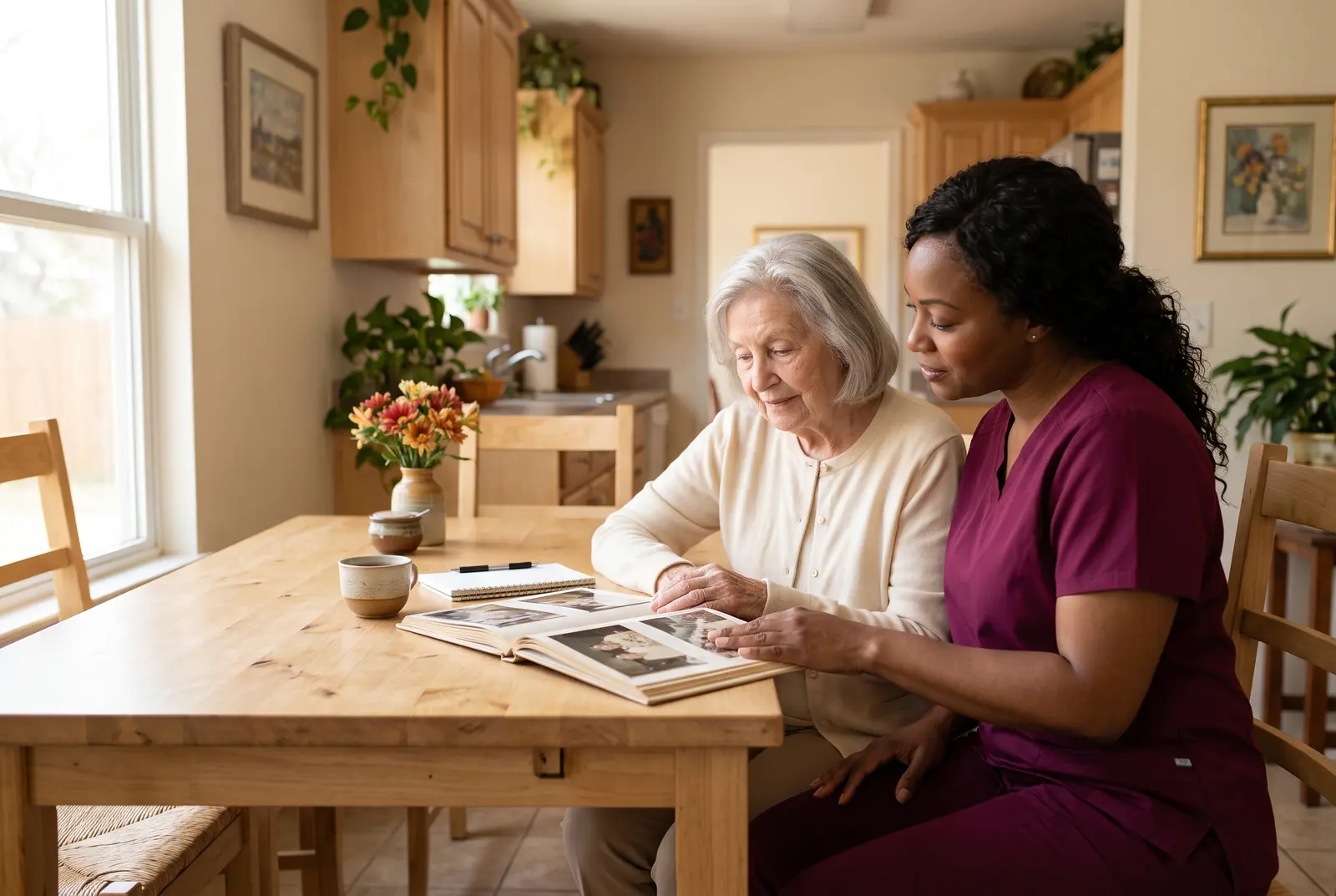
You Don’t Have to Figure This Out Alone
Caring for someone living with dementia is one of the hardest things a family can do. You may be worried about wandering, nighttime confusion, missed medications, sudden mood changes, or simply keeping your loved one safe while you work. Many families wait until they are completely worn out before they ask for help.
Quality Care Referral Network helps families in Plano and across the Collin County area explore memory care communities and residential care homes that offer memory support. Our help is free to families, and we focus on the details that matter most in dementia care: staff training, supervision, daily routines, and how caregivers respond when a resident is anxious or upset.
What Is Memory Care?
Memory care is a type of residential care for people living with Alzheimer’s disease or other forms of dementia. It usually offers:
- A secure environment designed to reduce the risk of wandering
- Caregivers trained in dementia care and communication
- Structured daily routines that reduce confusion and anxiety
- Help with bathing, dressing, eating, toileting and medications
- Activities matched to each person’s abilities: music, simple crafts, sensory activities, gentle exercise
- Closer supervision during the day and at night
Memory care may be offered in a dedicated building, in a separate unit within an assisted living community, or in a smaller residential home that is set up for memory support.

When Is It Time for Memory Care?
There is no single moment, but families often start looking when:
- Your loved one has wandered, gotten lost or left home at night.
- Safety risks are growing: stove left on, doors unlocked, falls.
- Medications are being missed or doubled.
- Personal hygiene or eating has declined significantly.
- Agitation, sundowning or sleep problems are hard to manage at home.
- The current assisted living home can no longer meet their needs.
- The family caregiver’s own health is suffering.
Talk with your loved one’s doctor about changes you are seeing. A medical evaluation helps clarify needs, and we can help you understand which settings may fit.
Understanding Alzheimer’s Certification in Texas
This is something many directory websites never explain. In Texas, a certified Alzheimer’s assisted living facility or unit has requirements beyond an ordinary assisted living license, including additional dementia-specific staff orientation, supervised training and annual education. A Type B license alone does not mean a facility is certified for Alzheimer’s care.
Facilities without Alzheimer’s certification may still serve residents with dementia, and Texas rules require dementia training for their staff too. The important thing is to ask each provider directly about its certification, staff training and how that training is documented. Our Texas training guide explains the basics.
Questions We Help You Ask on a Memory Care Tour
- What dementia training have the caregivers who would work with my loved one completed?
- How many staff are on duty during the day and overnight?
- How do you prevent and respond to wandering?
- How do caregivers respond when a resident becomes anxious, agitated or refuses care?
- What does a typical day look like? How are familiar routines kept?
- How do you support eating and track weight and fluids?
- How and when do you update families about changes?
- What would make a resident need to move to another setting?
- Is the facility or unit certified for Alzheimer’s care in Texas?
Memory Care in a Large Community vs. a Small Home
Some people living with dementia do well in a larger, purpose-built memory care community with secured courtyards and structured programming. Others are calmer in a small residential home with fewer people, less noise and the same caregivers every day. We help you think through your loved one’s personality, stage of dementia, mobility and budget to decide which environment is likely to work best.

Dementia Care Is About the Whole Person
A diagnosis does not tell the whole story. When we talk with you, we want to know how your loved one communicates, what comforts them, what they enjoy, the music they love and the routines that make a good day. Sharing this with providers helps them care for the person, not just the condition. Read more in Dementia vs. Alzheimer’s: what families should know.
Paying for Memory Care
Memory care usually costs more than standard assisted living because of the extra staffing, training and security involved. Most families pay privately. Long-term care insurance and some veterans benefits may help, and Texas STAR+PLUS may help pay for certain services for people who qualify (not room and board). Always ask for written pricing and verify benefits with the plan or agency.
Memory Care Questions
Does memory care cost more than assisted living?
Usually, yes, because of extra staffing, training, supervision and secured environments. Ask each provider for written pricing that shows the base rate and any care-level charges.
When is it time to consider memory care?
Families often start looking when safety concerns increase: wandering, getting lost, leaving the stove on, missed medications, or caregiver exhaustion at home. A conversation with your loved one’s doctor can help clarify needs, and we can help you explore settings that may fit.
What is a certified Alzheimer’s assisted living facility in Texas?
In Texas, a certified Alzheimer’s assisted living facility or unit has requirements beyond an ordinary assisted living license, including additional dementia-specific staff training. A Type B license alone does not establish Alzheimer’s certification, so ask each provider directly.
Can a small residential care home care for someone with dementia?
Some can and some cannot. It depends on the home’s license, staff training, supervision, and the person’s specific needs. We help you ask the right questions so the provider can confirm whether it is a safe fit.
Talk With Someone Who Understands
Call or send a short message. We will listen first, then help you explore memory care options near your family.